TOWARDS OTHERWISE EXHIBITING
The other day, while she moderated an online event, they talked about dance and death.¹ For some reason, her guest said that for a long time he had never seen his favorite dance piece live, but through video documentation only. Once he did see it live — he didn’t like it anymore. That reminded me of something I should mention or even start from when introducing Otherwise Exhibiting. This was an important understanding I had some years ago that came up during a conversation with another artist when we realized that we had learned art history and contemporary art’s recent tendencies from books only, through texts accompanied by mostly black and white image reproductions. This was because we were far from the museums and galleries that keep and present these works. So, we learned how to experience the artwork not by being next to and/or contemplating it, but while reading about it. For us the image reproduction was enough proof that the artwork exists somewhere or that a described event happened. Anyway, that’s how history can be perceived: through trust and the reconstruction of the event — in the present readings of the leftover traces. When I finally had the chance to see some of those art pieces in European museums, I felt nothing was added to what I had already experienced from these artworks through tiny reproductions in books. Moreover, inside the museum setting, I felt as if I was looking at copies of the original work, detached from their context and their present time. I was slightly ashamed of that. I thought that there was something that did not develop in my sensibility, something that I had to achieve to be able to fully read and contemplate these art pieces in their presence. It was only later, while reading more about experimental art practices, that I accepted as valid that my desires and artistic excitement about art don’t have to be concentrated on an object or piece. I focused on what can happen only in the event — here and now and in the potential transformation by every attempt of its repetition or reproduction. It became all about the conditions that create.
If you would close this book, then open randomly on any given page and read it, what you have just read becomes part of this script and consequently for the lecture “Towards Otherwise Exhibiting,” by ‘kunstenaar, consultancy tentoonstellingen.’ Perhaps you can close this book now and come back after you have finished reading that random page.
READING BETWEEN THE LINES
They helped me understand that Otherwise Exhibiting is a position to affirm a territory of activity such as exhibiting — that is able to involve not only the space of exhibition and its extensions (the website presentation, the catalog, the interview…), its agents (artist, curator, designer, technician, audience…) but also the time before the opening and after the closing of the exhibition — to then propose a shift, to declare a disconformity, to make a perturbation which would allow for a space of freedom and transformation of what is already given (habits, prejudices, accustomed ways of operating…),² in this way, the forms of publicness become a necessary element of artistic research.
It is also about playfulness or performativity with conditions that would otherwise be disempowering or controlling.
I write this now from the reading room of the National Library in Podgorica. It is February 4th 2021, and I am trying to remember what it’s like to be in a seminar, because this is a script for a lecture, for a seminar that eventually turned out to be a book. The room could’ve been similar to the one that I am sitting in now. There are books all around and if we would just arrange the tables to face each other, the space could work as a seminar setting. But it is not. Each of us in this room is sitting at least two meters away from each other. Each of us looking into a book or computer screen. In observation, I became curious about what other people are reading and writing and the impossibility of interaction with them, which is conditioned by the protocols of this space, becomes the main focus of my attention.
“Public yet solo”³ — with these words she proposed that we participate in her instruction-based durational piece for libraries.⁴ This piece started with an invitation, we were asked to meet her on Monday, around noon, in the lobby of a library in Brussels. We were asked to bring: a library card or an ID card to register for a library card — so that one can have access to the reading room; a smartphone or laptop (with charger if necessary) and earphones — for listening practice; a pen — so one can take notes, when instructed to do so; and water, snacks and/or lunch if needed — since it would take us up to five hours to go through the prepared reading and listening material.
I saw familiar faces in the room, holding the same papers containing the instructions. These papers laid out the time for reading and listening with instructions for breaks as well. We would cross each other in the lobby, sometimes sharing thoughts about what we read or reflecting on where we were, but mostly talking about whatever would cross our minds. There was a sort of a bond, as if in secret, for those holding the same paper. Paradoxically, while we were reaffirming those protocols that create the structure of the public space, we were making them our own. This for example could otherwise be exhibiting.
Often, I tend to think that I might have an obsession with a kind of form that not only gives shape to meaning but shapes meaning itself. It is not a feeling that I can’t control, but it is an obsession in the way that it operates as a powerful idea on how to be an artist and it anticipates the predictions of possible change to what is valued and recognized as art(istic) work.
She comments: “Yes, also my obsession. Differently phrased: How can the symptomatic instigate change / be free / be sovereign?”⁵
4 BUGS ENTER THE FRAME OF A LEAFLET. THEY PRETEND TO BE LEAVES.
You will get to know her better soon. We both see speech as a material act. She made me reconsider parasitical tactics in my artistic work when she had us over for a performance in her living room. After reading a script about being a parasite she then went to make us lunch, leaving for us her research notes and materials — asking us to become her and play out her research, if we wanted to. “Parasites are both a part and not a part of the host’s body, neither entirely self nor non-self.”⁶ “Artists who work parasitically take the context (the site, its history, its claims to authority, its funding and organizational structures, and its habits) as the primary material being occupied and consumed.”⁷
This year we met more parasites when we came together to make the exhibition “This situation that has developed over a long time.” She wrote “With the exhibition, we are trying to open up a space for reflection on the conventions of setting up exhibitions and the conditions to which we thereby agree. In order to be able to declare anything at all in the field of the visible, we have to mimic the strategies that already exist, to appropriate them, not in spite of, but because of the forces in the field of art. If we use and work with what is already available to us in the institution, then we re-appropriate the framework of the exhibition and think about how we can populate the space to perhaps allow for other approaches to creating areas of visibility.”⁸
Four of them who pretend to be artists accept the invitation to enter and inhabit the exhibition space of the institution. They look at the floorplan and decide to enter the archive. They want to learn about what happened there before so they can relate their attempts to similar approaches in the history of the institution. For the benefit of the institution, they end up digitalizing and structuring some of the archival material. They move parts of the archive into the exhibition space.
Another looks at the floorplan and they decide to close one of the exhibition rooms. They make a door and this room becomes an artist’s studio, a working space where she can write her theses for the duration of the exhibition. The room remained closed to the visitors. As a result, the institution gets a residency program of sorts.
Four of them who pretend to be artists accept the invitation to enter and inhabit the exhibition space of the institution, but before they do so, they prepare. They spend hours talking with each other, to understand how they should go about this. The space pretended to be an empty one, so they let the remnants of the previous exhibition guide what will be now present in the space and where. They print notes of their conversations on the walls, as documentation of what potentially the exhibition could have been. A week before they enter, they draw and read cards relating to artistic anxieties to help them talk over doubts and uncertainties that this exhibition produced.
Besides the exhibition space they are also invited to use the space of a leaflet, a printed A3 sheet that guarantees that the exhibition took place once it’s over. They want to explore how to inhabit this structure too. Using the gallery design template they create another version of the leaflet, marking a parallel event of the card-reading session that took place before the exhibition was open to the public.
anxiety — GUESTHOST — RELATIONSHIP
4 bugs enter the frame of a leaflet. They pretend to be leaves.
Leaf bug 1: I feel like being a guest or a trans-passer almost.
Leaf bug 2: I don’t know if sometimes I should just be a bug and stop pretending to be a leaf.
Leaf bug 3: There is this tension of being symptomatic of a system and then you want to do something against it but that is also symptomatic.
Leaf bug 4: The work you have to do is creating circumstances in which something can be invoked, and that you can also manage those things that you call forth. It is magical work — working with things that are invisible, forces that go beyond our control.*⁹
CARD-READING ABOUT ARTISTIC ANXIETIES
Since 2019 we perform one-on-one card-reading about artistic anxieties with and for artists. For this I made a deck of cards titled 7 anxieties and the World. Inside the box: a deck of twenty-two cards, an instruction sheet and a stone that is made out of chocolate.¹⁰
Each card refers to an object I picked up from exhibitions or other kind of public presentations. Take-away material, stuff like invitations, postcards, things that can be taken away but also some that are perhaps not meant to be. In the instruction sheet of 7 anxieties and the World there is also a reference to the artist and the event from where each object was collected. During the card reading, a card can carry a slightly different meaning or function from that which has been originally attributed to the object within the public presentation it originated from.
“7 ANXIETIES AND THE WORLD” IS A SEVEN-CARD SPREAD:
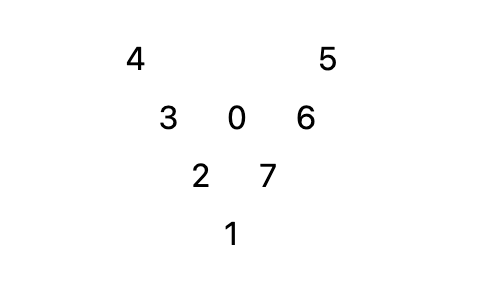
In the spread above, the number 0 refers to ‘the World’ and is represented as a chocolate stone that comes inside the box with the deck of cards. The chocolate stone symbolizes the appearance of the world as a stone, as one, dependable, steadfast and permanent while it is digestible and you can crush it in many pieces. The stone should remain in the position of the number 0 while the reading takes place, as a reminder of what is truly desired, although it can be eaten at any moment, but since there is no resolution in the cards to the posed question(s) it is suggested to finish the reading by eating the stone. Or not. Something about completing a full circle.
The 7 anxieties in this card reading are developed from 7 anxieties that I’ve previously defined while developing the project Archiving Artistic Anxieties:
- the anxiety related to the fact that life and art are intertwined but exhibited separately.
PAST
- the anxiety related to understanding exhibiting as a collaborative practice that is overlooked by the established structures of exhibitions.
- the anxiety related to the fact that exhibitions produce artistic practices, therefore recognized as symptomatic without agency.
- the anxiety related to an exhibiting practice that moves between and depends on multiple stable places, meaning that the practice can never really change these stable places.
PRESENT
- the anxiety relating to exhibiting the ephemeral as center.
- the anxiety relating to Otherwise Exhibiting illustrating change or indulging in academic rhetoric.
- the anxiety of Otherwise Exhibiting becoming resilience training for an otherwise exhibition.
AND THE WORLD.
If there is not ‘and the World,’ I guess there won’t be any anxieties. But saying ‘the World’ is also a problem since the world is never a world. It is worlds, many worlds in constant transformation.
Drawing from the seven-card spread, the artist talks about their practice, looking for a question in relation to:
- the interconnectedness of life and art
IN THE PAST
- the influence of others
- the course of production
- possibility of influencing the institutional
IN THE PRESENT
- endeavors and attempts towards not confirming the center
- experiencing challenges related to the possibility of doing ‘differently’
- hidden influences relating to the unseen but present, what one can sense but doesn’t yet know about and crushes the World, eats it and digests it.
7 anxieties and the World is a tool for conversation, a performance and a proposal for research methodology. It is also an example of Otherwise Exhibiting: experimentation with the form of publishing artistic research while it takes place.
— The first card is the individual who is fearful but excited.
— I think maybe it will be redundant. Something about individuality: in some kind of way, … that links with how feelings orient our look. The ambiguity of ego. Doing better than the other. Looking at the look.
— You mean: an individual with some kind of a vision that immediately puts him or her as the one who knows? Something like this, or…?
— Yeah, something like: Why should I look at this look?
— Ahaaa.
— I mean: the gaze. The problem is there.*¹¹
THERE IS NOTHING TO LOOK AT — LET’S DO OUR NAILS AND READ ABOUT AFFECTS
It’s the beginning of May, 2021. I am sitting in the collective studio at a.pass, in Brussels. It is early in the morning, a bit chilly, but sunny. I sit alone in this huge space, behind a table that is also huge. In a few hours, others will start coming in, soon we will be laying on a blue carpet, touching hands and reading theoretical texts to each other. She and I, joined to propose a formalized but relaxed situation, a hybrid form of what can be mentoring, functioning as a reading group. We prepared a reader with preselected texts — recent writings on affect theory but also some that we personally associated to affect theory. We also brought with us a bunch of nail art accessories. We wrote that we want to take care of each other, to talk about what makes us happy and why we feel how we feel (reading Sara Ahmed) to prepare for the “age of anxiety” (reading Lauren Berlant), to learn how we can repair (reading Eve Sedgwick) and to “re-enchant the world” (reading Silvia Federici). Excited to put in relation the manicure and mentoring: as both are rituals of preparation that serve the appearance in public.¹²
I am noticing that this format of being together, but also the whole period till now of conceptualizing, facilitating and organizing a post-master artistic research program, is something I could imagine doing within an exhibition. The drive or the excitement would be slightly different in that case, but still, it would be about exploring the infrastructure of art in order to undergo an intimate, beautification and self-care process, to form an army of reading bodies that extend their capacity to connect to others and to other situations.¹³
It remains an open question and an interesting problem, how different my responsibilities would be in these two different environments.
— Negative criticism on the side.
I have decided not to talk about what I can only relate to with negative critique. I repeat this because, for me, it was a significant movement. Also, a big challenge.
— Yeah, you lose half things to say.
Wow, I just had a weird feeling in my head. Felt like something between my skull and my brain is applying pressure to my mind. Felt like my brain was getting smaller in my head. And then I had, I had a little zzzzz, and I thought I was gonna faint. But I never faint.*¹⁴
ECOMING THE KUNSTENAAR, CONSULTANCY TENTOONSTELLINGEN
She said every research project has a story, which is a story of an arrival.¹⁵ This is another kind of story perhaps, yet I keep on thinking how those stories of arrivals are often linked with bureaucratic processes.
After spending the last many years in Belgium as a student and researcher, at the beginning of 2020 I applied for a “professional card for foreigners,” which allows non-EU citizens to be self-employed in Belgium. The application was based mainly on recommendation letters, which prove that I bring ‘cultural value’ to Belgium. Those letters described in detail my activities as an artist, worker and researcher. Emphasizing that my experience and technical assistance in the production of museum exhibitions and my work as a professional artist and researcher, dealing with the dynamic structure of exhibition-making, complement and inspire each other.
The result was positive as it was recognized by the Flemish government (Department of Work & Social Economy — Economic migration), I was able to prove what I do is a type of professional artistic activity with the expertise of consultancy for exhibition-making. And so I received the professional card with the profile of ‘kunstenaar’ and to my surprise, also ‘consultancy tentoonstellingen.’
This recognition brought excitement in the otherwise anxiety-filled bureaucratic procedures that occupied most of my time in Belgium, since moving from Montenegro. I felt again the joy of conceptual artistic thinking and began to think about every document, generated through this process, as a potential work of art. This fantasy helped me suppress some of the worries and doubts lingering, about if I could actually make it to be self-employed, as some steps were still needed for that to happen.
As a ‘kunstenaar, consultancy tentoonstellingen,’ I opened a one-person company and named it Adrian Lister.¹⁶
Eventually, the bureaucracy took an unexpected turn. Although I had a registered company that I started to work under, my residence permit was rejected. Later, a lawyer explained to me that it would be easy to appeal the refusal, but while waiting for the decision, I wouldn’t be able to work in, or leave Belgium. This could take half a year and by then I would have to renew my professional card, which would be impossible since I wouldn’t have been able to work till then. These vicious circles were nothing that I haven’t experienced before, but this time I decided not to be pushed again into that helpless and uncertain position of being in limbo. So, I left Belgium and returned to Montenegro. I didn’t expect I would feel so relieved while suddenly leaving everything behind. On the other hand, almost one year later, I still feel as if I am just passing by Montenegro for a short visit to see my mother.
To finish the story of the company Adrian Lister: The Business Counter (which is a mediating organization between the government and entrepreneurs) did me ‘a favour,’ by not obliging me to pay the contributions for the days that the company was opened, and so they officially closed Adrian Lister on the same day it opened. It all looks now like a perfect scam or conceptual artwork.
However, because of this experience I began to think of my work and research as the activity of consultancy. I applied to several open calls to programs and residencies for artists, asking them if they would be willing to host this experiment and allow me to develop and probe what has already been recognized as my ‘consultancy’ expertise. In turn, the consultancy would involve other participants, curators, lecturers as well as visitors. Even though this profiling was formalized through bureaucratic means and entrepreneurial language, this kind of studio practice could open up a parallel space for exchange and intimate communication that would get its shape also in relation to the institutional conditions. Till now, no positive answer has arrived.
“It’s a serious proposal, not an illustration of something.” she said. Presenting herself as a trade artist and feral economist, she “files a brief report” to the curators and runners of the institutions who might be in the audience, that it is “extremely difficult to transition from doing a one-time stunt: of being invited to give a talk or to exhibit her work, to doing something persistent in the institution.” It is about a shift from being part of a curated event to being implemented in operational processes, from not hacking the infrastructure but actually being the infrastructure. She continues emphasizing that for example, for an artist to enter the administration, as an artist, is “an extraordinary and almost impossible feat to do other than in a stunt-like setting.” She also said that she is particularly concerned with a “ravine that exists in the arts between content and infrastructure.”¹⁷
She is the first feral artist I came to know. It was back in 2018¹⁸ and since then I haven’t met any other. She has a grocery import-export business, of coffee, green tea, oil and other goods, where all suppliers and customers are her friends, their families and friends. The goods are distributed inside travel luggage, using the already existing movement of people within the infrastructure of art. She says that she “hitchhikes in the cultural baggage of artists on art residencies, curatorial junkets, people on the conferences circuits.” The project is a humorous and serious proposal to think “how the capacity of art infrastructure can be and should be used to manage other goods.” Pointing at the untapped value of the “imperiled yet wealthy infrastructure of art.” Which is not a neoliberal approach to value, “Because the relationships that come through these interactions are unfathomable.” The Feral Trade project is thus in a way supported and sponsored from those art spaces and institutions that originally supported the travel of the artist or other cultural workers (through their luggage). In this way it also hijacks the curatorial and institutional selection and decision-making processes. She emphasizes that the Feral Trade goods and objects are also highly collectable, giving the example of how some have repeatedly entered the staff office collection at the Tate Modern.
To become ‘kunstenaar, consultancy tentoonstellingen’ is a serious proposal, not an illustration of something. It is about inhabiting this given role, to explore the limits of its framework. In language as well as in its functional meaning.
The word ‘consultant’ comes from Latin: consultare, meaning ‘to deliberate.’ To make decisions, as a result of careful thought. To be made, given or done with full awareness of what one is doing. To be done consciously and intentionally, carefully and unhurriedly.¹⁹ In the economy that created consultancy as a profession for providing expertise within a specialized field, the consultant sells her advice on how to proceed in a given process. The advice is rational and objective and the purpose is utility maximizing. The client lacks this expertise or needs support for what he is unable to fulfill.
If my consultancy is a method for Otherwise Exhibiting, then the job would be a deliberate shift in thinking of exhibiting as a mode of operating that creates practices. To chew over, consider, contemplate, debate, kick around, meditate, mull (over), perpend, ponder, wrestle (with), study, think (about or over)²⁰ how unhelpful conditions might be subverted to become the foundation of artistic practice. Economic exchange to be developed and established is not sustained by the principle of individual profit but is driven by the interest of the community that created the field. For now, it is a parasitic one, not letting go from the already existing infrastructures. The support this consultancy is providing would not in this case come from an absolute necessity or the lack of knowledge, but from a desire to make the knowledge shareable. The consultancy session looks for other motivations beside personal success for group interactions and actions.
Otherwise Exhibiting stands for the performative events that tend to coincide with developing research methodologies. I see this as radical.
She comments: “Me too, in the sense of radical meaning ‘having roots,’ transformation that goes all the way down to the roots.”²¹
The problem of this comparison of artistic activity with consultancy remains the relative power when implementing a change within the organization. A consultant has influence over an individual, group, or organization, but has no direct authority to implement changes. It’s awfully similar to how an artist is invited to enter the exhibition space. Their freedom is defined through their mobility and non-belonging.
ANXIOUS PARASITES WILL SAVE THE WORLDS²²
I do and do not take place within a proper body. I am pretending to be an artist, and that’s the only way I can be one. I am you and you are not only yourself. You were not supposed to inhabit this role in the first place. You irritate. You are foreign. You continuously associate with and detach from, without the delusions of consensus. You are looking for a device that sees the relations forming. You start from giving a speech which at times turns to conversation. You want to appreciate noise as an integral part of this communication. Noise becomes an extension for your artistic means to interfere, disrupt, feedback, and disperse the meaning as it gets formed. You are looking for what is ‘next to,’ ‘with’ and ‘detached from’ but sitting on the relation. You and I form a relationship that is in constant alterity with itself, shifting between intimacy and alienation.
In relation to our common languages and histories, we recognize (self)censorship driven by our own interests and benefits you and I derive from it. We find it challenging to think about what comes after pushing the walls or exposing their (hidden) structures, sitting on the relations between those walls, formed by their structures. We don’t expose, we negotiate our interdependence.
We wish to form a subvisible world, one which is crucial to the larger worlds we are part of. In this sense, we are not interested so much to describe the world of art and certain positions of (im)potencies of the artist as anxious parasites in relation to it, but more to allow and make visible the different and many concerns, doubts, apprehensions in their interconnectedness.
Our anxieties can be the symptom of fluttering hope that is like those of posttraumatic stress disorder, with the difference that the apparently absent cause of perturbation lies in the future, rather than in the past.
FOOTNOTES
¹ Referring to the artist Sofia Caesar moderating a conversation with the performance curator André Lepecki (online as part of the Terrarium Talk Movement in the Pause: Choreopolicing, ‘Expressing Oneself’ and the Pandemic, organized by Intermedia Research Unit of LUCA School of Arts Brussels, 10 March 2021.) To reference this event is not only to start from an anecdote, but also to create a link to Sofia’s art practice on agency in the performativity of the body to move its conditions.
² Inspired by a written feedback from Irene Revell, Victoria Perez Rojo, Mathilde Villeneuve and Lilia Mestre, within the research program of a.pass (advanced performance and scenography studies) in Brussels.
³ ⁴ Ivory Weber, Eleanor (2017). From the text announcing the event The World Today All In The Mind. Royal Library of Brussels. The recollection of the event is further described in the text.
⁵ Pia Louwerens’s comment from the online essay Archiving Artistic Anxieties (www.archivingartisticanxieties.me) that gives an insight into parts of the process, which shaped the concept Otherwise Exhibiting. Published and produced with the support of a.pass and the Royal Academy of Fine Arts Antwerp, February 2020. Editorial Team: Pia Louwerens, Goda Palekaitė, Kristina Gvozdenović (comments of sorts) and Sina Seifee (website).
⁶ Louwerens, Pia. From I to we — Excavating reality together, at home [performance]. 2017. Pia was most probably referring to The Parasite by Michel Serres (1980).
⁷ Post Brothers and Fitzpatrick, Chris (2011). A Productive Irritant? Parasitical Inhabitations in Contemporary Art. Filip 15.
⁸ Aplinc, Urška. This Situation has Developed Over a Long Time [exhibition text]. April 2021. ŠKUC gallery, Ljubljana.
⁹ 4 Anxieties and This Situation [parallel exhibition leaflet] for This Situation has Developed After a Long Time [exhibition]. 2021. ŠKUC gallery, Ljubljana.
¹⁰ Actually, the chocolate stone is Candy cabin milk chocolate pebbles stones retro sweet shop traditional old-fashioned candy. 1kg, 24 euro and 20 cents. Ordered from Amazon.
¹¹ Notes from the card-reading session, performed within the program Victories over the suns. 2019. Zsenne gallery, Brussels.
¹² Referring to Sara Manente and our collaborative proposal for collective learning, Nail Art Affects Reading Sessions, curating the block Not in the Mood. 2021. a.pass, Brussels.
¹³ “And you have to remember that the way we live, it is always entirely embodied, and that is never entirely personal — it’s never all contained in our emotions and conscious thoughts. That’s a way of saying it’s not just about us, in isolation. In affect, we are never alone. That’s because affects in Spinoza’s definition are basically ways of connecting, to others and to other situations.” Massumi, Brian (2015). Politics of Affect, chapter Navigating Movements. Polity Press.
¹⁴ Note from the card-reading session, performed in the Pink House residency, Antwerp. 2019.
¹⁵ Ahmed, Sara (2012). Referring to the first sentence of On Arrival, the introduction to the book On Being Included. Duke University Press.
¹⁶ While filling in the necessary information for opening a one-person company, I was asked to give it a name other than mine for my commercial activities. I was sure that this new profiling of my artistic activity had something to do with whoever is now Adrian Lister. Adrian Lister was born in 2013, as a (mis)translation of my name, Adrijana Gvozdenović — when inserted in the most commonly used online machine-translation service. Without any etymological connection between the two surnames, I started to search what was the target text for Adrian Lister carrying over the source text of Adrijana Gvozdenović. This anecdote instigated the thinking behind the ongoing project Who is Adrian Lister?, which as of now, has taken shape as an MFA thesis, and as three performances followed each by a separate artist publication. Adrian Lister was twice invited to facilitate online interviews in artistic research projects: for the presenting company Mnemosyl (exhibition EROTX by Aurora Zachayus, Ateliê397, São Paulo, 2016) and with the Researcher>1, (lecture-performance A Research Parkour in >1 steps by Stefania Assandri, Renata Lamenza, ARTICULATE research program, Antwerp 2021).
¹⁷ Rich, Kate. How Global? Session 4: Kate Rich — Feral Trade & Closing Address [talk within an international conference exploring new directions in public art collecting]. 2016. Bristol Museum and Art Gallery.
¹⁸ Rich, Kate. Critical Administration (Shaking down the Entrepreneur) [workshop]. 2018. a.pass post-graduate program.
¹⁹ Merriam Webster dictionary.
²⁰ Some of the synonyms for ‘to deliberate,’ Merriam Webster dictionary.
²¹ Louwerens, Pia (2020). Archiving Artistic Anxieties [online essay].
²² The title was first used for the lecture Developing strategies from the artistic anxiety of being invisible and useless or Anxious Parasites will save the worlds at the Royal Academy of Fine Arts Antwerp, October 2019. This chapter is written appropriating parts of texts of other authors who are mostly already mentioned in earlier footnotes. The last sentence refers to Timothy Gould’s interpretation of Emily Dickinson’s poem putting close the feeling of hope and the feeling of severe anxiety: Hope is the thing with feathers / That perches in the soul. From the notes of the essay: “Paranoid Reading and Repetitive Reading, or You’re so Paranoid, You Probably Think This Essay is About You” (in Touching Feeling. Affect, Pedagogy, Performativity by Eve Kosofsky Sedgwick. 2003.)
Published in the book The Artist Job Description, Vijai Patchineelam, Track Report (Royal Academy of Fine Arts Antwerp), OAZA BOOKS and a.pass. 2022.