Who is Adrian Lister? — Recollection after the gatherings in Arbeitsraum/Ausstellung at nGBK, for Gastarbeiter 2.0: Arbeit means Rad
What is a space that is (or is not) a workroom and an exhibition space at the same time, and what kind of sociality does it imply?
I think about this when I think about Adrian Lister. Our relationship started as a joke but turned into a serious life situation. More than a decade ago, when I first moved countries, I decided to inhabit this relation — to stay in translation. It became an opportunity to challenge existing notions of identity, migration and cultural labor. When I ask, “Who is Adrian Lister?” I ask what it means to be an artist, or where I am speaking from when I talk. And I tend not to be alone when I ask these questions. It’s a research tool and a sharing method.
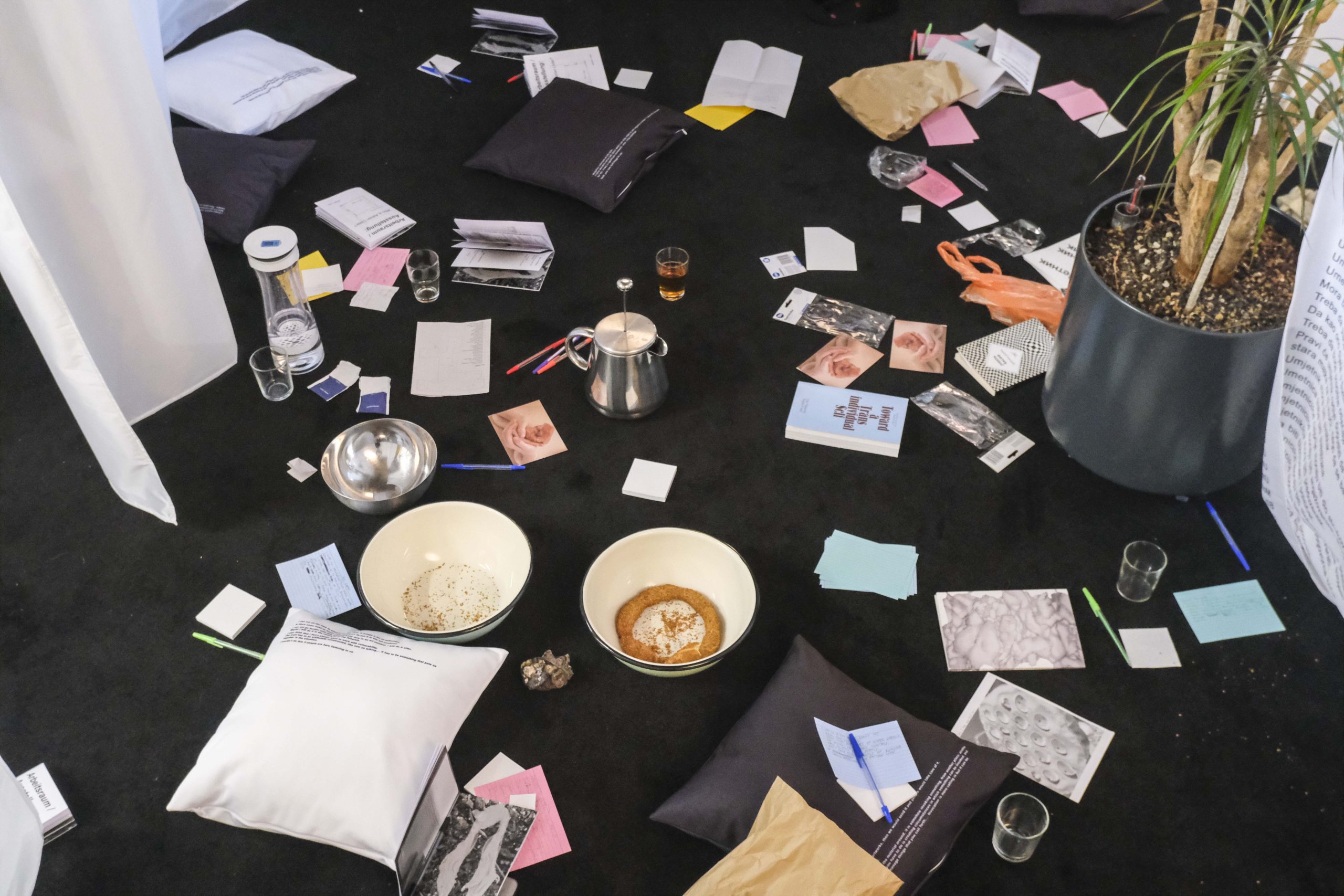
The latest iteration of Who is Adrian Lister?, exhibited in 2024 under the title Arbeitsraum/Ausstellung at nGbK in Berlin, responds to the architecture of nGbK’s space itself and the room marked as Arbeitsraum/Ausstellung (“workroom/exhibition”) on its floor plan. The installation invited visitors to reflect on what it means to exist between these two spaces — on the slash between working/exhibiting, or labor/showcasing.
What lies between the workroom and exhibition can be defined as a study room – a studio, where something is studied (studio comes from the word study after all), and which implies a kind of sociality. With this in mind, visitors were invited to join events in the Arbeitsraum/Ausstellung room on two occasions, with the following announcement: “This is a hangout invitation, a possible work session, or a study situation about living in/through translations and how this movement can create different forms of being and doing.”
Cultivating an environment of study, reflection, and exchange, the works in the installation serve as props for the gatherings. I incorporated elements of language, tools, and symbols connected to my experiences while asking who Adrian Lister is.
The curtains feature photographs of “germanisms”—words that have been borrowed and transferred from the German language into Bosnian-Croatian-Montenegrin-Serbian. These words, often related to professions and tools, emphasize the duality of work and representation. The recurring motif of šljaka—a word that evolved from the German die Schlacke (or “slag” in English for discarded industrial material) to signify ‘work, job’ in BCMS—underscores the link between labor, language, and identity.
These comment on my recent relocation to Germany, through my evolving relationship with the German language. Other elements reflect the attitude with which Adrian Lister and I can enter the exhibition space and conceptual framework, together.
To stay in translation means to be carried across different structures back and forth, being neither one nor another. It is not about empowering identities to act successfully; to stay in a movement asks for another kind of engagement. And for this, you need other people. You need to make friends.
When invited to exhibit their work, the artist enters the institution as a guest, or more precisely as a guest worker (Gastarbeiter). While their freedom is defined by this role, their long-term impact on the institution is limited at the same time. Making a space for gathering was therefore an opportunity for a guest worker to extend the invitation to others and expand on this guest-host relationship.
Ko je Adrian Lister? — osvrt na okupljanja u Arbeitsraum/Ausstellungu u nGbK-u, za Gastarbeiter 2.0
Šta je prostor koji jeste (ili nije) istovremeno radna soba i izložbeni prostor, i kakvu društvenost podrazumijeva?
O tome razmišljam kad razmišljam o Adrianu Listeru. Naš odnos je počeo kao šala, ali se pretvorio u ozbiljnu životnu situaciju. Prije više od deceniju, kad sam se prvi put preselila u drugu zemlju, odlučila sam da živim ovaj odnos – da ostanem živjeti u prevodu. Postao je to način da zakomplikujem postojeće predstave o identitetu, migracijama i kulturnom radu. Kad pitam Ko je Adrian Lister?, pitam šta znači biti umjetnica ili odakle govorim dok pričam. Trudim se da nisam sama kad postavljam to pitanje, koje onda postaje istraživački alat i metoda dijeljenja.
Najnovija iteracija Ko je Adrian Lister?, predstavljena 2024. pod nazivom Arbeitsraum/Ausstellung u nGbK-u u Berlinu, odgovara na arhitekturu samog prostora nGbK-a i prostor označen na mapi kao Arbeitsraum/Ausstellung („radna soba/izložba“). Instalacija je poziv posjetiocima da razmisle šta znači postojati između ta dva prostora – na međi između rada/izlaganja ili truda/prikazivanja.
Ono što se nalazi između radne sobe i izložbe može se definisati kao soba za učenje – prostor studija, gdje se nešto istražuje (riječ studio u korijenu ima studiranje), što podrazumijeva određenu društvenost. Imajući to u vidu, posjetioci su pozvani da prisustvuju događajima u Arbeitsraum/Ausstellungu u dvije prilike, uz sljedeću najavu: „Ovo je poziv na druženje, moguću radnu sesiju ili situaciju učenja o životu u prevođenju i kako ovo kretanje može stvoriti različite oblike postojanja i djelovanja.“
Kultivišući atmosferu za učenje, refleksiju i razmjenu, radovi u instalaciji služili su kao rekviziti za okupljanja. Uključila sam elemente jezika, predmeta i simbola povezanih s mojim iskustvima dok sam postavljala pitanje ko je Adrian Lister.
Zavjese su prikazivale fotografije germanizama – riječi koje su posuđene i prenesene iz njemačkog jezika u bosanski-hrvatski-crnogorski-srpski (BHCS). Te riječi, često povezane s profesijama i alatima, naglašavaju dvojakost rada i reprezentacije. Ponavljajući motiv „šljake“ – riječi koja je od njemačke die Schlacke (ili „šljaka“ na engleskom za otpadni industrijski materijal) evoluirala u značenje “rad, posao” u BHCS jeziku – dodatno naglašava vezu između rada, jezika i identiteta.
Ovi elementi reflektuju moje nedavno preseljenje u Njemačku, kroz odnos s njemačkim jezikom koji je u razvoju. Ostali aspekti odražavaju stav s kojim Adrian Lister i ja zajedno ulazimo u izložbeni prostor i konceptualni okvir.
Ostati u prevodu znači prelaziti naprijed-nazad kroz različite strukture, ne biti ni jedno ni drugo u potpunosti. Nije u pitanju osnaživanja identiteta za uspješno djelovanje; ostati u pokretu zahtijeva drugačiji oblik angažmana. A za to su potrebni drugi ljudi, potrebni su drugovi i drugarice.
Kada umjetnik ili umjetnica dobije poziv da izloaži svoj rad, ona ulazi u instituciju kao gošća, ili preciznije, kao radnica-gošća (Gastarbeiter). To znači da je njena sloboda definisana određena ovom ulogom, ali je kroz ovaj privremeni status istovremeno njen dugoročni uticaj na instituciju ograničen. Stvaranje prostora za okupljanje bila je, stoga, prilika za gastarbajterku da otvori ovaj poziv i time proširi domaćinsko-gostinjski odnos.
published in Gastarbeiter 2.0 – Arbeit means Rad, eds. Hannah Marquardt, Andrej Mirčev.
neue Gesellschaft für bildende Kunst, Berlin, 2025